Share this article

Table of Contents

How AI Is Transforming the Way We Work and Think: A Comprehensive Guide

How AI Is Transforming the Way We Work and Think: A Comprehensive Guide

Key Takeaways

  • AI is enhancing daily work practices by automating routine tasks.
  • AI drives more informed decision-making through data analytics.
  • Creativity is augmented by AI, allowing for innovative focus.
  • Productivity is increased as AI manages repetitive tasks efficiently.

Key Answer

AI is fundamentally changing work by enhancing human capabilities, boosting creativity, streamlining decision-making, and improving productivity. It shifts the focus from replacing jobs to empowering professionals to achieve more with greater efficiency.

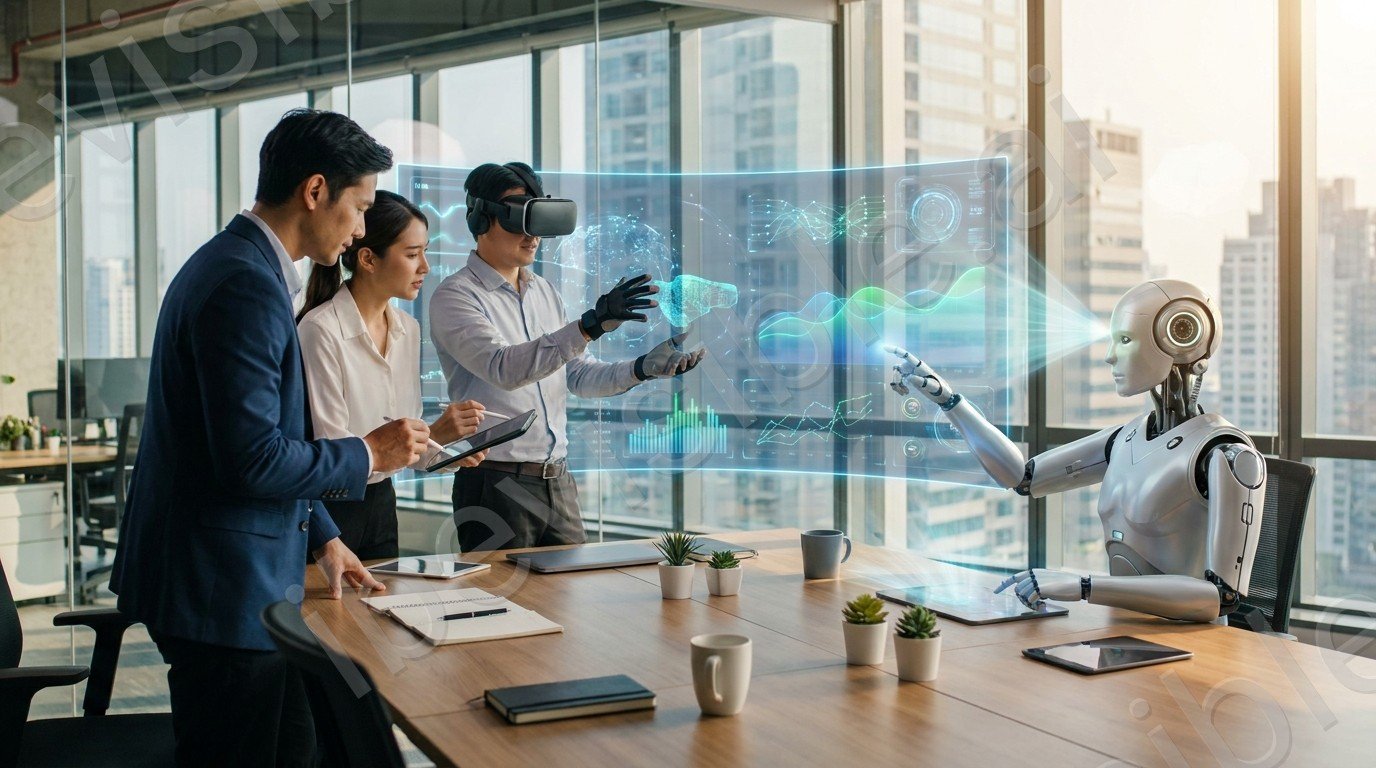
In today’s rapidly evolving world, artificial intelligence (AI) is a game-changer, revolutionising the way we work and think. As AI continues to integrate into various aspects of daily business operations, it is shifting paradigms from the feared notion of job displacement to becoming an invaluable ally in enhancing human capabilities. This article delves into the multifaceted impacts of AI on work practices, decision-making, creativity, productivity, and problem-solving, underscoring its potential to redefine the professional landscape.

AI in Daily Work Practices

The infusion of AI into daily work practices has brought about significant transformations. From automating mundane tasks to providing insights through data analytics, AI is streamlining processes and allowing professionals to focus on more strategic initiatives. Advanced AI systems can now handle customer inquiries, schedule meetings, and even manage basic project tasks autonomously, freeing human resources for more complex and creative endeavours.

Moreover, the integration of AI into workplace tools has led to more personalised and efficient workflows. AI algorithms analyse user behaviour to suggest optimised ways of completing tasks, tailoring solutions to individual work styles. This not only enhances productivity but also creates a more engaging work environment.

Enhancing Decision-Making with AI

Decision-making in the corporate sphere has been revolutionised by AI through its ability to process vast amounts of data quickly and accurately. AI-driven analytics provide decision-makers with comprehensive insights that are critical for making informed choices, thus reducing the risks associated with business decisions.

AI tools use predictive analytics to foresee market trends and consumer behaviour patterns, enabling businesses to strategise effectively. These tools also facilitate scenario planning by simulating potential outcomes, thus providing leaders with a robust framework to anticipate challenges and opportunities. As a result, AI empowers organisations to make data-driven decisions that are faster and more reliable.

Expert Perspective

AI Integration Specialist

In the evolving landscape of work, AI represents not just a technological advancement but a fundamental shift in how humans interact with and leverage technology. It allows professionals to transcend traditional boundaries of productivity and creativity, making workplaces more dynamic and innovative.

AI and the Evolution of Creativity

AI is not merely a tool for automating tasks but is also becoming a catalyst for creativity. By handling routine aspects of creative work, AI enables individuals to focus on the more innovative elements of their roles. For instance, AI can generate initial drafts or suggest ideas, which professionals can then refine and build upon, enhancing the creative process.

In fields like marketing, design, and content creation, AI assists by providing creative inputs that humans might overlook. These AI systems are trained to recognise patterns and preferences, which they apply to produce unique and engaging content. Thus, AI fosters an environment where human creativity can flourish, augmented by technological precision.

Boosting Productivity with AI

Productivity in the workplace has seen significant enhancements thanks to AI technologies. AI-driven automation reduces time spent on repetitive tasks, allowing employees to focus on high-value activities that require human insight and judgement. This shift is instrumental in improving overall efficiency and productivity.

AI applications in workforce management also play a crucial role. By analysing performance metrics, AI systems can identify bottlenecks and suggest improvements. This proactive approach helps in maintaining a smooth workflow and reducing downtime, thereby maximising productivity.

AI in Problem-Solving

AI’s role in problem-solving is transformative, offering unique solutions to complex issues. AI systems analyse large datasets to identify patterns and anomalies that may not be visible to human analysts, providing insights that drive innovative solutions.

In industries such as healthcare, finance, and engineering, AI is used to model scenarios and predict outcomes, offering strategic advantages. These capabilities enable organisations to tackle challenges with precision and speed, ultimately leading to more effective problem-solving strategies. AI’s ability to learn and adapt over time also means it continually improves its problem-solving prowess, making it an indispensable tool for modern enterprises.

Frequently Asked Questions

AI enhances creativity by handling routine tasks, allowing professionals to focus on innovative aspects. It suggests ideas and drafts for creative work, which humans can further develop.

AI aids decision-making by analysing data to provide insights, predict market trends, and simulate scenarios, enabling faster and more informed business decisions.

AI boosts productivity by automating repetitive tasks, analysing performance to identify improvements, and allowing human resources to focus on high-value activities.

Yes, AI excels in problem-solving by analysing large datasets for patterns, modelling scenarios, and predicting outcomes, providing strategic solutions across various industries.

AI is shifting from replacing jobs to enhancing human capabilities by automating mundane tasks and empowering professionals to focus on complex and creative roles.