
Key Takeaways
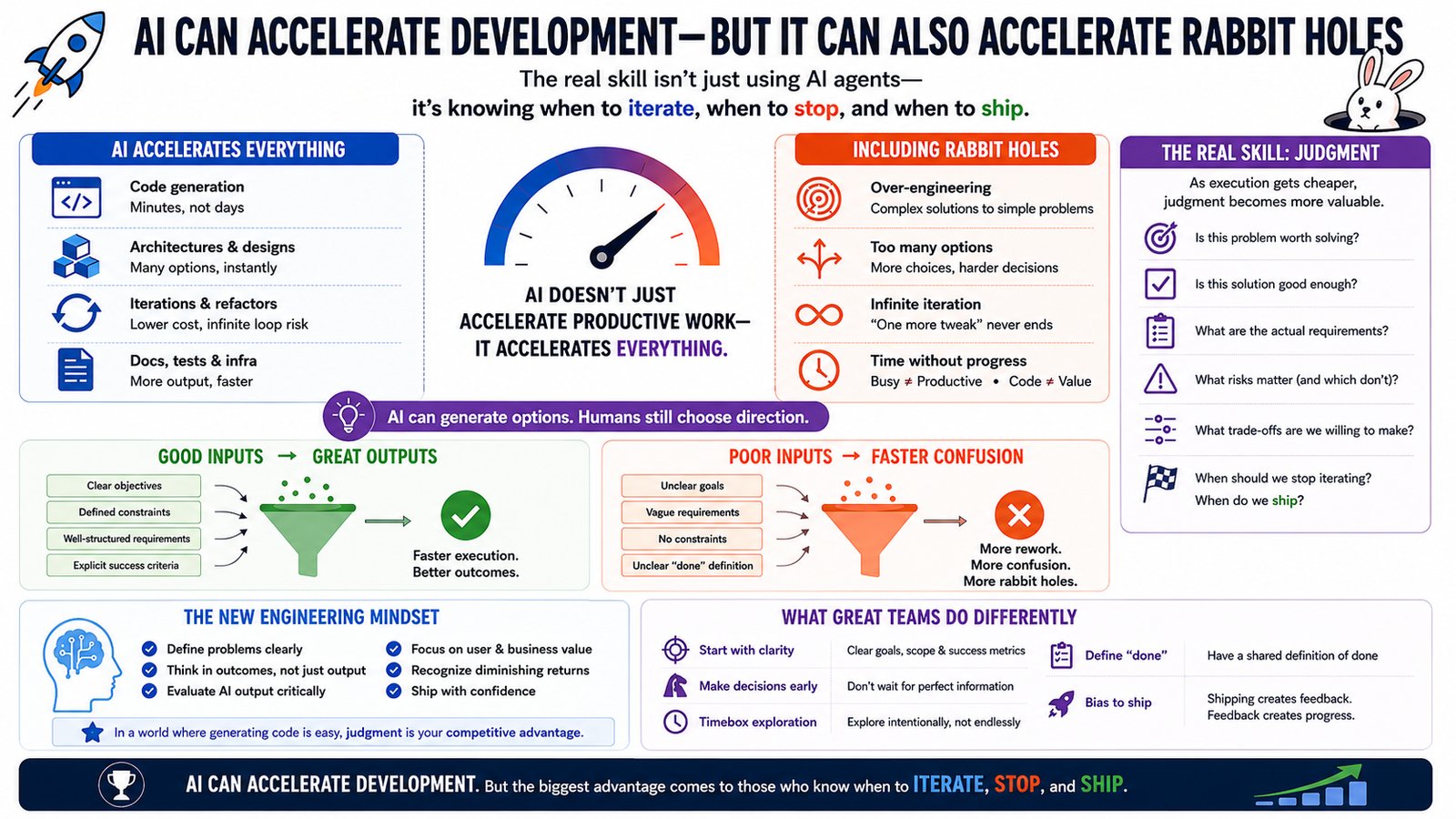
- AI accelerates both productive and unproductive activities, necessitating a balanced approach.
- Traditional productivity metrics are increasingly inadequate in AI-enhanced environments.
- Recognising Rabbit Hole Indicators can prevent wasted effort and focus on value-driven development.
- Practical strategies like time-boxing and regular reviews can optimise AI’s role in development.
Key Answer
AI can accelerate development by enhancing speed and productivity, but it also risks expanding rabbit holes where efforts are wasted on less impactful tasks, especially in Australia’s dynamic tech sector.
In the bustling Australian tech landscape, a pivotal question has emerged: “How much faster can AI make developers?” From claims of 20% productivity gains to audacious promises of 10x engineers, the software world has been captivated. Yet, as AI tools have surged in capability, the anticipated transformation in development timelines hasn’t always materialised. While some teams race forward, others become ensnared in the paradox of productivity: more code, less progress.
AI’s ability to accelerate isn’t confined to productive work. It accelerates everything, rabbit holes included. This has been a revelation for Australian tech firms exploring AI’s potential. The discussion now centres not just on speed but on strategic code selection, balancing AI’s dual-edged prowess in development.
The Double-Edged Sword of Acceleration
AI’s impact on development is profoundly dualistic. In pre-AI eras, an Australian developer exploring new architectural patterns might spend days conceptualising and prototyping. Today, AI enables multiple implementations within minutes, offering a plethora of solutions–each needing careful evaluation. This shift from typing speed to decision-making speed is transformative yet challenging.
AI’s prowess lies in its capacity to bring ambitious architectural ideas to life rapidly, but it also invites the risk of over-engineering. What once took significant manual effort can now be achieved with simple prompts. However, the resulting complexity often requires more time to manage, blurring the lines between progress and stagnation. Thus, AI presents a new challenge: discerning which code should endure and which should be discarded.
When More Code Creates Less Progress
Traditional productivity metrics in software development–lines of code produced, pull requests merged, and features generated–are becoming increasingly misleading. AI facilitates unprecedented code generation, but this doesn’t necessarily equate to solving core problems.
Many Australian teams find themselves tangled in AI-generated solutions that are perfectly ‘good enough’, yet they invest days in refining these iterations. This focus on quantity over quality leads entire sprints to vanish into optimisation efforts that deliver scant customer value. The paradox is evident: more code can mean less actual progress.
Expert Perspective
AI Development Consultant
AI’s role in software development is undeniably transformative, yet requires a balanced approach to maximise benefits. As we navigate this digital evolution, recognising when AI serves us–and when we start serving it–is paramount.
Understanding Rabbit Hole Indicators
To navigate AI’s complex landscape, Australian developers must recognise specific Rabbit Hole Indicators–red flags signalling AI’s diminishing returns. These indicators include:
Recursive Prompting: Repeatedly refining AI prompts leads to diminishing productivity, indicating a need for manual intervention.
Over-Engineering: When AI suggestions favour complex solutions unnecessarily, it can create long-term maintenance burdens.
Debugging Sinkholes: Spending excessive time on AI-generated code that perpetuates bugs or ‘works’ but lacks clarity suggests a return to basics.
By identifying these indicators, developers can implement ‘Human-in-the-loop’ protocols–set exit points where AI reliance must be scaled back. This approach positions developers as pragmatic leaders in AI sustainability.
Practical Guardrails and Time-Boxing
Implementing practical guardrails is essential for Australian teams striving to harness AI effectively. Time-boxing AI usage–allocating specific durations for AI-driven tasks–prevents endless iterations and promotes timely decision-making. This approach ensures AI remains a tool for enhancement, not a distraction.
Furthermore, architectural complexity should be scrutinised. AI suggestions that introduce unwarranted complexity must be challenged, with simpler, more maintainable solutions favoured. Regular code reviews focusing on AI-generated content can prevent complexity creep, ensuring that development remains aligned with business goals.
The Sunk Cost Fallacy and Dunning-Kruger Effect
Two psychological phenomena are prevalent in AI-augmented development: the Sunk Cost Fallacy and the Dunning-Kruger Effect. The former leads developers to continue investing in problematic AI-generated solutions due to the perceived value of previous investments. The latter affects junior developers who may overestimate their understanding due to AI’s assistance, creating technical debt difficult to resolve.
Australian software teams must be vigilant against these biases. Encouraging a culture of open critique and regular training sessions on AI tool use can mitigate these issues. The goal is to foster an environment where AI enhances skills without obscuring knowledge gaps.
Frequently Asked Questions
AI accelerates development by automating repetitive tasks, generating code, and suggesting architectural solutions, freeing developers to focus on more complex problems.
Rabbit Hole Indicators are signs that AI’s productivity is declining, such as recursive prompting, over-engineering, and prolonged debugging without resolution.
Teams can avoid this fallacy by regularly reviewing AI-generated work, being willing to abandon complex solutions, and focusing on solutions that add real value.
It’s a cognitive bias where inexperienced developers overestimate their skills due to AI assistance, potentially leading to unmanageable technical debt.
Practical guardrails include time-boxing AI tasks, challenging unwarranted complexity, and conducting regular code reviews to ensure alignment with business goals.