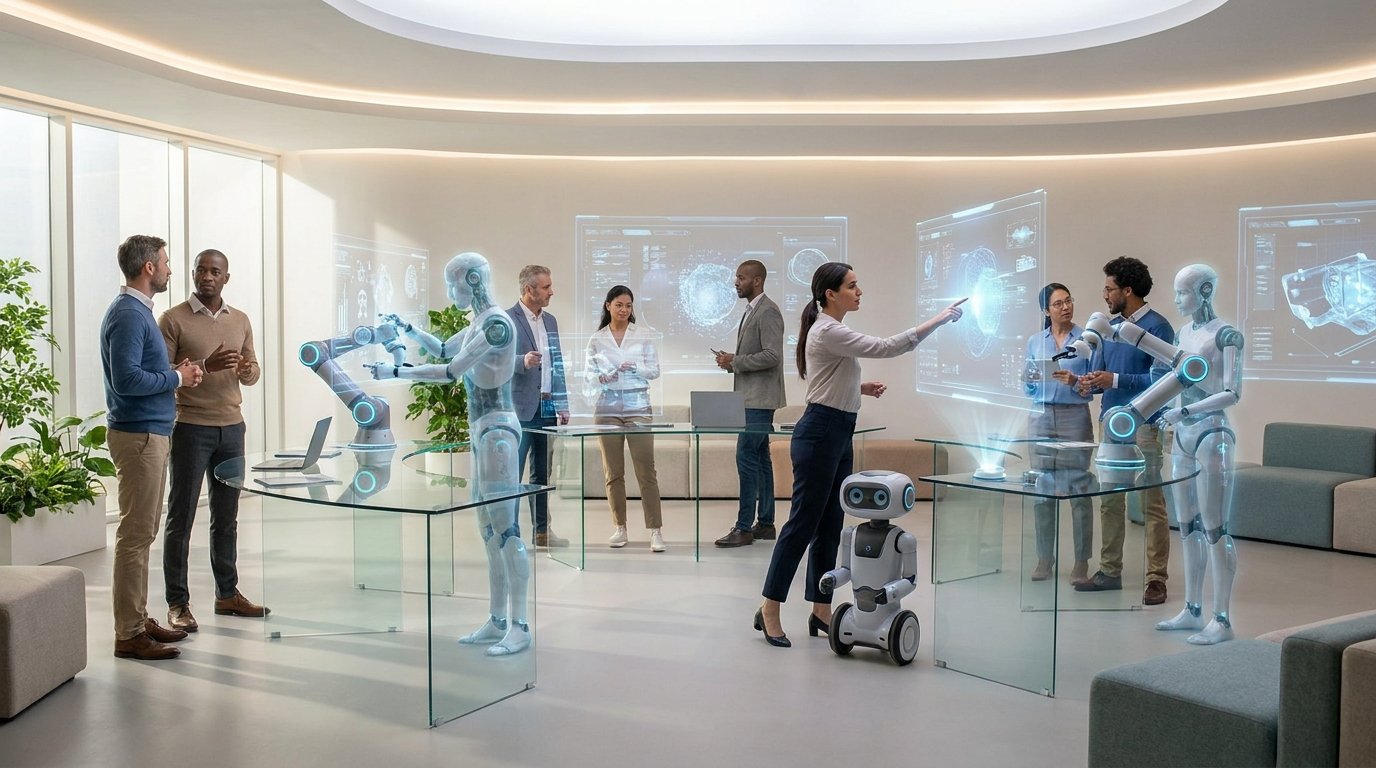

Key Takeaways
- The shift from AI tools to AI agents is transforming business operations by enabling more autonomous decision-making.
- Human-in-the-loop frameworks are essential to balance automation with ethical decision-making.
- Multi-Agent Orchestration enhances operational efficiency through specialised task handling.
- Economic considerations should weigh initial investment against long-term benefits of adopting AI agents.
Key Answer
The shift from AI tools to AI agents is redefining human-machine collaboration by transitioning from mere automation to dynamic interaction, enhancing efficiency and decision-making.
In recent years, the landscape of artificial intelligence has experienced a significant transformation. The evolution from traditional AI tools to autonomous AI agents marks a pivotal moment in human-machine collaboration. This shift is not merely about technological advancement but signifies a fundamental change in how businesses operate and interact with AI-driven systems.
Understanding the Evolution: From Tools to Agents
AI tools have long been pivotal in automating repetitive tasks, enabling organisations to streamline operations and reduce manual effort. However, these tools operate based on predefined instructions and lack the capability to adapt independently. This is where AI agents come into play. Unlike traditional tools, AI agents possess the ability to learn and make decisions autonomously, functioning much like an intelligent colleague rather than a mere extension of a user’s capability.
The transition to AI agents involves a conceptual leap from task execution to task management. This evolution allows agents to assess situations, learn from interactions, and make informed decisions without constant human oversight, a change that aligns with emerging industry trends.
Sense-Think-Act Cycle: The Core of Agentic AI
At the heart of this transformation lies the ‘Sense-Think-Act’ cycle, an operational model that enables AI agents to function effectively in dynamic environments. This cycle starts with ‘Sense’, where agents collect and perceive data from their surroundings. This is followed by ‘Think’, which involves processing the information and determining a course of action. Finally, in the ‘Act’ phase, agents execute the decision, completing the loop.
This cycle distinguishes AI agents by their ability to adapt and respond to new information in real-time. The cycle’s iterative nature allows for continuous learning and refinement, ensuring that the AI agents improve over time with each interaction.
Expert Perspective
AI Integration Specialist
The shift from AI tools to AI agents represents a transformative leap in how businesses interact with technology. By adopting AI agents, organisations can significantly enhance their operational efficiency, although the shift requires careful management of both technical and ethical considerations. The potential benefits, including reduced error rates and enhanced decision-making, make this transition a strategic priority for forward-thinking businesses.
Implementing Human-in-the-Loop (HITL) Oversight
One of the critical aspects of integrating AI agents into business processes is establishing robust Human-in-the-Loop (HITL) frameworks. This approach ensures that while AI agents operate independently, human oversight remains integral, particularly in decision-making processes that require ethical or sensitive judgement.
HITL oversight provides a safeguard against potential errors and biases that autonomous systems might develop. It enables businesses to leverage the efficiency of AI agents while maintaining control over the final outputs, thereby balancing automation with human expertise. According to insights on AI and human collaboration, this integration is crucial for achieving reliable outcomes.
Multi-Agent Orchestration: A New Era of Collaboration
The concept of Multi-Agent Orchestration (MAO) extends beyond deploying single AI agents. It involves coordinating multiple specialised agents that collaborate to accomplish complex tasks. This setup mirrors a symphony orchestra, where different instruments (or agents) work in harmony to produce a coherent outcome.
MAO enhances operational efficiency by allowing specialised agents to handle distinct components of a task, leading to quicker and more accurate results. This orchestration requires sophisticated management strategies to ensure that agents function cohesively, and aligns with the emerging perspective of navigating the future of human-machine partnerships.
Economic Implications: The Cost of Agency versus Task
As businesses transition to AI agents, understanding the economic implications is crucial. The ‘Cost of Agency’ refers to the investment in developing, deploying, and maintaining AI agents, while the ‘Cost of Task’ represents the resources required for traditional methods of task execution.
Comparative analyses indicate that, although initial investments in AI agents can be significant, the long-term cost benefits are substantial. Agents reduce operational costs by increasing efficiency and minimising errors, providing a solid return on investment. Businesses must weigh these factors against their specific operational needs to determine the viability of adopting AI agents.
| Factor | Cost of Agency | Cost of Task |
|---|---|---|
| Initial Investment | High | Moderate |
| Operational Efficiency | High | Low |
| Error Rate | Low | High |
| Long-term ROI | High | Moderate |
Frequently Asked Questions
AI agents have the capability to learn and make autonomous decisions, unlike traditional AI tools which rely on predefined instructions.
HITL oversight ensures ethical decision-making and provides a safeguard against errors and biases in AI systems.
Although the initial investment can be high, AI agents offer significant long-term cost savings by improving operational efficiency and reducing error rates.
It involves coordinating multiple AI agents, each with specific specialisations, to collaboratively accomplish complex tasks.
It is an operational model where AI agents sense their environment, think by processing data, and act by executing decisions autonomously.